

Many small business owners wonder whether they need a website. If you are wondering the same in 2024, the answer is, ‘Yes, you need a website.

The COVID-19 pandemic has altered the retail space, with millions of shoppers online looking for everything from clips to books to houses to natural gas and more. Even if you are not selling anything online, a website will show people you actually exist and bring them to your brick-and-mortar store.
Simply put, if you don’t have a business website, you are losing business to competitors that already have one.
So, don’t waste more time in deciding to have a well-designed website for your small business. And don’t forget to buy a domain name that is memorable and easy to understand to cement your online presence.
Ready to design a well-optimised, attractive website for your business? Let us help you on that front by delving into the website design best practices.
- Keep it simple, stupid! (the KISS principle)
KISS is an acronym for Keep it simple, stupid!, which is a design principle first noted by the US Navy in 1960. This principle states that most systems work best if they are kept simple rather than complicated, and it holds true for designing websites.
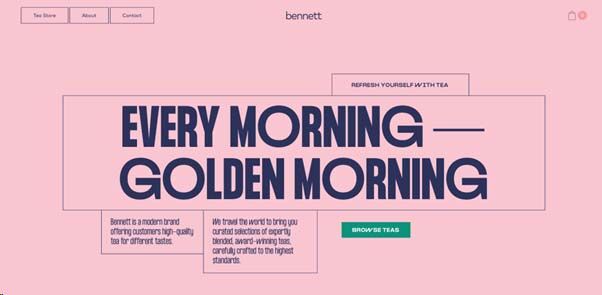
A minimalistic, clean design helps users focus on the message without unnecessary distractions. Avoid cluttered pages filled with too many elements that can overwhelm visitors. Instead, focus on ample white space, clear typography, and a simple colour scheme reflecting your brand.
A fine example would be Bennett Tea. Bennett is a modern brand offering high-quality teas for different tastes. They have a straightforward website design with a consistent colour scheme and clear typography to guide users towards relevant information.
- Mobile responsiveness is non-negotiable
With over 60% of web traffic coming from mobile devices, it is crucial your small business website is mobile-friendly.
A responsive design ensures your website looks and functions well on any device, regardless of the screen size. Plus, a mobile-optimised website also improves your ranking in Google’s mobile-first indexing.
- Fast loading speed
Studies show that 53% of mobile website visits are abandoned if pages take more than 3 seconds to load. Even a 2-second delay in load time results in abandonment rates of up to 87%.
What’s the fix?
Your website must be optimised for speed by compressing images, using a reliable WordPress hosting site, and minimising unnecessary plugins and scripts.
- Engaging and clear CTAs
Your website should guide visitors toward specific actions, whether it is making a purchase, signing up for a newsletter, or contacting you for services.
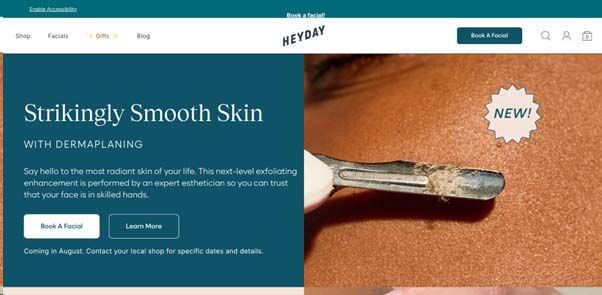
Use easy-to-understand, prominent call-to-action (CTA) buttons that stand out on the page. Avoid using vague CTAs like “click here” and instead use action-oriented text like “Start your trial” or “Get a free quote.”
Take Hayday, for example. They have elegantly and clearly shown CTAs throughout their website design to attract the attention of their potential customers.
- Highlight your services or products
Whether selling services or products, you must prominently showcase them on your homepage. Leave no room for ambiguity.
For example, if you are a boutique clothing store, appealing and crisp images of your trendy apparel can capture the attention of your potential customers.
However, don’t go too crazy with the images. Avoid overlaying your website with graphics or images. Choose a few standout product shots and feature them on the homepage. The rest can be featured on the interior pages.
Take HOBBS, for example. They have featured their bestsellers and categories on the homepage with visually appealing images to compel visitors to probe further.

- Easy navigation
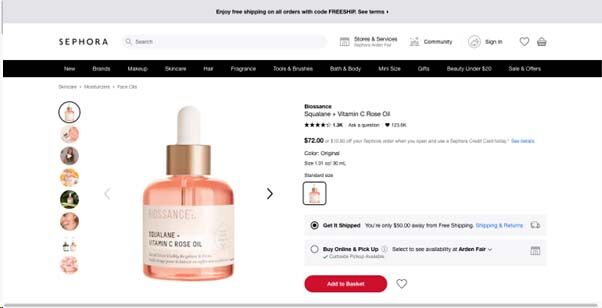
A well-designed business website is one that can be easily navigated. Good website navigation is characterised by a menu bar (primary navigation bar) with clear language telling visitors what they will find when they click on a page (for example, about, contact, or services). These signposts must be simple, clear, and relevant to your website.
It would also help if you place a navigation map in the footer of your website, a search bar so visitors can search for specific keywords, and breadcrumbs on each page to track the journey of the visitors, allowing them to retrace their steps if required.
Take Sephora, for example. You’ll see that the website has a clear top menu where you’ll see different categories of their products, store locators, your cart, and the sign-in/up option. The breadcrumbs are displayed underneath the main navigation on the shop and product pages.
- Leverage customer testimonials
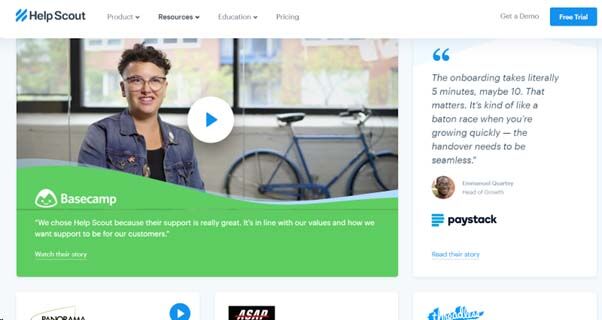
When you are designing a small business website, the most powerful tool at your disposal is customer testimonials. Showcasing what customers think of your business helps to build trust and shows the real-world benefits and uses of your products or services.
Take Help Scout, for example. Their website design features detailed customer testimonials, showcasing the effectiveness of their customer support tool.
- Use high-quality images and visuals
Attention-grabbing images are an integral part of any website. It helps balance text by visually engaging the viewer.
Visuals are considered to be more compelling as people are usually more moved by what they see versus what they read. Also, it is easier to process images and visuals than huge blocks of text. Last but not least, good-quality images keep a website from looking boring.
So, consider incorporating images and visuals into your website design in the form of photographs, GIFs, memes, infographics, animations, and screenshots. However, don’t overwhelm visitors with your visuals. Keep it simple!
- Don’t forget about SEO!
A well-designed business website is of no value if potential customers cannot find it. Incorporate basic SEO practices such as creating keyword-rich content, optimising meta tags, and ensuring fast load times. Also, remember to label your pages properly so that search engine crawlers can understand what your pages mean, along with creating proper titles for your images.
Implement local SEO strategies to attract customers from your target geographic area.
Summing up
Building an effective small business website is much more than just aesthetics. By focusing on mobile responsiveness, simplicity, user experience, and SEO, you can create a website that not only looks amazing but also drives engagement and conversions. Ensuring a fast loading speed and showcasing customer testimonials are key to capturing the trust of your potential customers.
Follow the website design practices outlined above and take inspiration from the examples to design a website for your small business that will ensure your success online.