

The beauty of a truly global world is that you can cater to a far broader pool of prospective customers.
To really make the most of this 8 billion-strong market opportunity, it’s essential that you have an appropriately optimised website.
In the wake of the Covid-19 pandemic, eCommerce has grown significantly on a global scale.
As lockdown measures forced many consumers to stay at home at all times, more users than ever discovered the vast potential of online shopping, and eCommerce saw far greater transaction volumes than ever before.
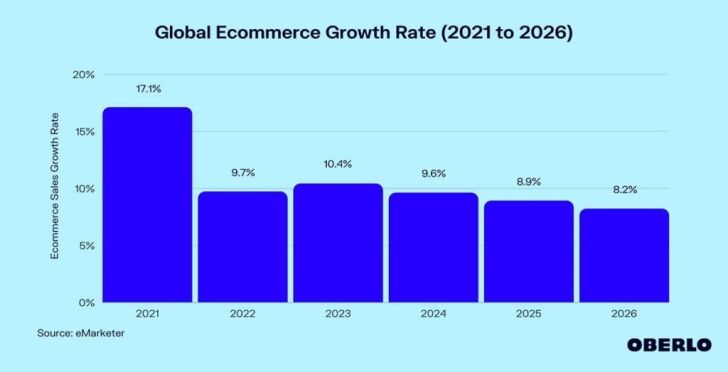
(Image: Oberlo)
As data shows, eCommerce is expected to continue to grow throughout the decade, maintaining growth rates that consistently exceed 8% into 2026.
This empowers retailers to continually find larger audiences and deliver more impactful conversion rates as time goes by.
But how can your website be better adapted for reaching a global online audience? And what key considerations must be taken?
Let’s take a deeper look at how retailers can build a thriving website for an international customer base:
Finding the Right Website Builder
When starting from scratch, the easiest way to create a retail website is through a dedicated website builder.
This helps you to get set up and sell products without having to draw on your coding experience to get off the ground.
Using the right website builder software can help you to:
- Utilise templates to make the website creation process faster
- Customise your templates
- Operate in a more cost-effective way than hiring professional web designers
- Discover a vast library of stock images and multimedia
- Tap into simple drag-and-drop tools
- Better adopt SEO tools for search engines
- Incorporate more customisation options when creating pages
Today, Shopify has emerged as a leading platform for eCommerce websites, but there are many other options including WooCommerce and Bluehost.
Creating an International Brand
When you’re looking to open your digital doors to overseas customers, it’s important to consider adopting an internationalised or multilingual domain name for your eCommerce store.
This doesn’t have to involve rebranding your entire company, but utilising a store name that’s easy to understand on a global scale can be a great advantage for an international-facing store.
Furthermore, it’s worth looking at domain names that can be written in characters other than the Roman alphabet. So, for a hypothetical company called ‘Top Stationery’ looking to sell in China, the Mandarin characters for Top Stationery can be included in its domain name.
Internationalising domain names means that stores can empower their customers to search and access sites in their native language.
In addition to this, many ICANN-accredited domain registrars can undertake this consideration on your behalf.
Keep Things Simple
When it comes to marketing a website on an international scale, less is certainly more.
Not only does marketing around the world mean that you’re tasked with optimising your website for vastly different bandwidths and browsers, but you’ll also need to take a vast array of different cultures into account.
Here, it’s best to keep things simple and avoid using more images that may not be culturally suitable on a universal scale.
Always Optimise for Mobile
Your eCommerce store must be as responsive to a desktop browser in the US as it is to a mobile-based shopper in Indonesia. In recent years, mobile eCommerce has become the dominant form of online shopping, and sales have accelerated to more than $3.5 trillion in the US alone.
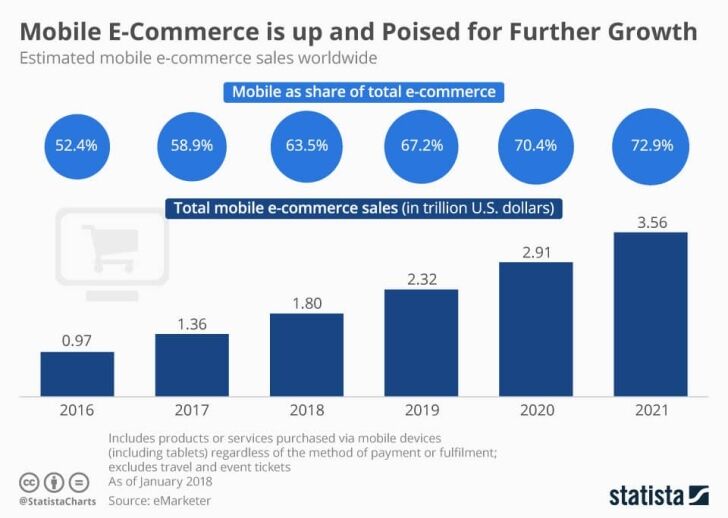
To accommodate this, it’s essential that your website works on every mobile device possible and on every mobile browser available. It’s also important to consider different levels of connectivity throughout the world, including the growing array of 5G ready smartphones entering the market.
Naturally, AMP (Accelerated Mobile Pages) is essential, but you can check on the performance of your pages across a range of devices using free tools like Google Lighthouse, which is a great way of ensuring that all of your potential customers are able to access your website.
Accommodate Local Languages
Significantly, 76% of online consumers prefer to buy from websites that are available in their native language. Furthermore, 40% of surveyed respondents from CSA Research claimed that they would never make a purchase from a website in a language that wasn’t their own.
When setting up an eCommerce store for consumers both domestically and overseas, it’s essential that you cater to local languages to ensure that customers trust your pages and have a frictionless experience on-site.
With this in mind, it’s worth enlisting the help of a professional translator or specialist agency to transform your English content into coherent local language copy.
Furthermore, you should always review on-site settings and form fields to ensure that they can accommodate variations in phone numbers and addresses.
If your forms are pre-populated with zip codes and US phone number formats, you’re likely to see damaging levels of cart abandonments from overseas visitors.
Thriving on the World Stage
The wave of digital transformation that swept the globe in the wake of the COVID-19 pandemic has inadvertently helped the world to get a little smaller.
This can present an opportunity for businesses that have ambitions to cater to international audiences.
While it’s essential to cater to overseas visitors by looking to build local-language domains and consider different browsers, the process of accommodating an international audience doesn’t have to break the bank and can bring excellent revenues as the eCommerce boom continues to gather momentum throughout the course of the decade.
- Custom web design
- Secure and fast website solution
- Full management training
- Take control of your website
- SEO optimisation
- Reliable web hosting and emails
Article by Pankaj Shah: DCP WordPress Web Design